Envelope of one item
Measure the full rectangular L, W and H of one finished product, including its cap, accessory or protective retail sleeve.
PRINTING MATERIAL / RIGID PACKAGING ENGINEERING DESK
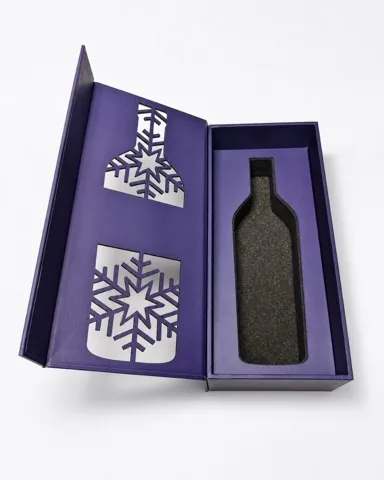
Plan a rigid or Kappa box interior around the real product—not just an attractive reference photo. Check rectangular product envelopes, quantity per box, cavity arrangements, clearances and the space your proposed insert needs.
Dimensions in mm · Planning assumptions visible · Sample approval required · Delhi NCR manufacturing

01 / DESIGN FOR WHAT GOES INSIDE
This tool handles identical rectangular product envelopes. Irregular-shaped, flexible or mixed assortments need separate measurements, detailed drawings and a sample.
02 / THE MATH, EXPLAINED
The calculation is transparent so your team can challenge every assumption before ordering.
Measure the full rectangular L, W and H of one finished product, including its cap, accessory or protective retail sleeve.
Add twice the chosen per-side clearance to both top-view dimensions. It is a planning allowance—not an agreed manufacturing tolerance.
Arrange identical envelopes in up to four columns. Rows are calculated from the number of items. Add your selected gaps and outside insert margins.
Check the inserted product, stability, opening, print and transit protection on a real, loaded sample before finalizing production dimensions.
Required top-view length = columns × (item length + 2 × side clearance) + gaps between columns + 2 × outside margin.
Required top-view width = rows × (item width + 2 × side clearance) + gaps between rows + 2 × outside margin.
Indicative internal height = item height + combined vertical allowance.
For rotated items, the length and width envelopes swap. Real board-wall construction, insert compression and lid fit must be engineered separately.
03 / WHAT A MANUFACTURER SHOULD APPROVE
A digital envelope can identify an obvious size conflict, but cannot predict real magnet alignment, drawer friction, material elasticity, lid engagement or safe shipping. Confirm these with your actual products.

COMMON ENGINEERING QUESTIONS
No. It checks an illustrative internal layout. External dimensions depend on rigid board, inner walls, wrapping paper, lid construction, insert tolerances and the assembly method, none of which are fully modeled here.
No. For bottle contours, rounded corners, fragile goods and multi-level trays, the actual item must be measured and a proper fitment drawing and loaded sample reviewed.
There is no universal value. Foam density, cover material, product fragility, fit friction and manufacturing variation affect the requirement. The displayed allowance is user-editable and not a company tolerance recommendation.
No. A reliable quote also needs production quantity, core board, wrap paper, opening structure, finishing, tooling, insert design, assembly and shipment planning.
Some fold-flat constructions are incompatible with permanently attached rigid insert assemblies. Consider a removable fitment, test assembly order and agree folded shipping dimensions.
Only for identical rectangular envelopes in one layout. Mixed-size kits need a custom cavity drawing. Decorative rigid boxes are not automatically certified for direct food contact; use the correct approved primary packaging.